Building the COSH website
This blog by Aadil Khalifa, a batch of 2023 IT student, talks about the process and steps followed during the design and development of the COSH website.


I came across the projects proposed for NITK Winter of Code 2021. Winter of Code is a program conducted in NITK with a format similar to Google Summer of Code (GSoC) that aims to help students get started with open source projects. The first project listed was 'Design and Develop a website for COSH.' Over the last couple of years, I’ve gained an interest in design. So I felt the project would be a good opportunity to work on a real-time project that would incorporate technology and design elements.
The project required using ReactJS, something I hadn’t worked with. I feel the best way to learn is to start doing and solving problems in a hands-on manner. When you start working on something, you face a lot of problems. Once you get stuck, you play with the code, change your code to see different results, optimize the code and try alternative approaches (finally finding the StackOverflow link that solves your problem). You eventually learn a lot of things that make you a better programmer.
We had about three weeks to submit a project proposal detailing how we would go about the project. I felt it was important to show some work done using ReactJS to make my application more credible. I rushed through Reach tutorials and built a design portfolio website and a basic blog website within that time frame. I drafted my proposal and submitted it.
Regardless of whether I was selected, I felt it was a good learning experience, challenging myself to learn a new framework in a limited time. A few days later, the list of selected candidates was released, and I was selected.
The Process
Once I was selected, I started my research to better understand the process of building professional websites. I worked on defining a strategy that would make sense for the project.
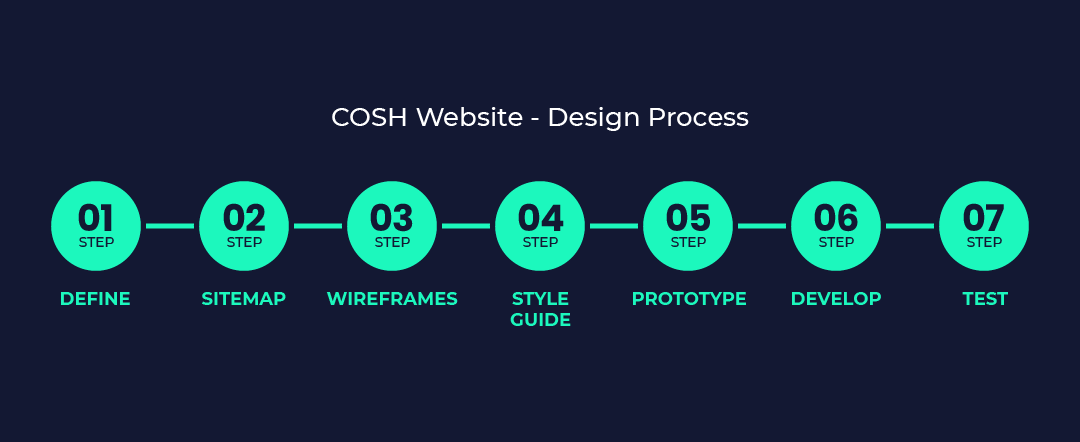
Define stage
The define stage is to better understand what we are trying to build. Here we ask questions like:
- What is the purpose/goal of the website?
- How can we express this visually through the website?
- Who are the stakeholders?
- Who is our target audience?
- What are we offering to our target audience?
Sitemap
The sitemap or information architecture refers to how information is structured in a website. The sitemap was designed considering the insights we got from the Define stage. Here we decided on all the information that the website should have, all the pages that should be there, which sections are more important, how pages should be arranged, and the navigation/flow of the website.

Wireframes
Wireframes visually represent the structure, space allocation, and content placement in a website. The wireframes were designed in Figma. Several different versions were created, which were compared and analyzed.

Style Guide
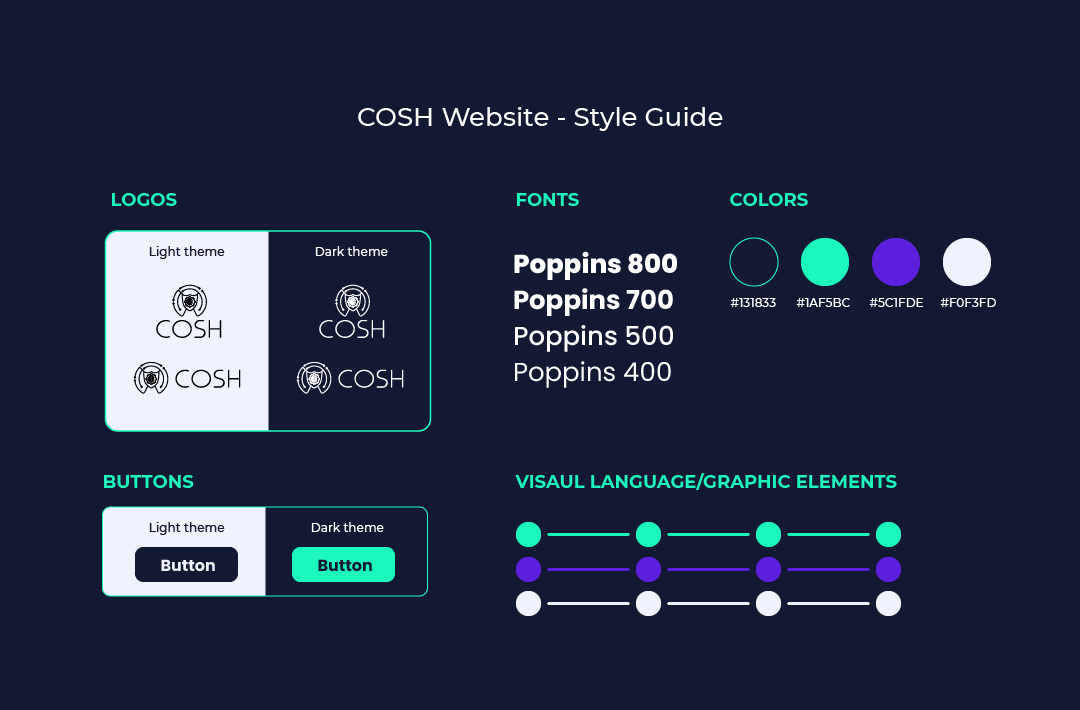
Here I worked on the visual look and feel of the website. I decided on the standard colors, typefaces, graphic elements, etc., to be used throughout the website. The purpose is to create a shared language and maintain visual consistency across different pages. On the COSH website, the graphic elements used are inspired by the version control nodes structure.
Prototype
A prototype is an interactive mockup of your web design. It visually represents how your website will look. The purpose is to test designs before developing them. Figma was used for prototyping. I designed mockups for the desktop version as well as the mobile version.
Develop
Here we implement the designs that we have created.
- ReactJS, a front-end JavaScript library, was used to develop the website.
- Sass, a more structured version of CSS, was used for styling.
- Firebase Firestore, a real-time document database, was used for storing data.
- Ghost, an open-source content management system, was used for managing the blog content.
- EmailJS, a Client-side email service, was used for mail functionality.
Test
We tested the website by asking a few people not involved with the project to go through it and provide feedback. The purpose of this is to get an outside perspective that may give us valuable insights that we may have missed. At this stage, we fine-tune the website and fix any possible bugs. We get it ready to go live!
Special thanks to Mohit P. Tahiliani, Govind Jeevan, and Akshay Revankar for guiding me throughout the project. Considering you’re reading this, the website is probably live, and everything works as intended (hopefully!).


